

About Our Study
Our Research Focus
Our Mission
Carbon Cybernetics are developing
carbon-fiber intracortical implants with improved biocompatibility, but predictive tools for their recording performance are limited. Signal fidelity is strongly influenced by electrode geometry and placement, yet 3D geometries (such as carbon fibers) remain largely uncharacterised. This study developed a computational framework to better predict 3D electrode behaviour in vivo.
Our Methodology
A hybrid NEURON-COMSOL FEM framework was used. This incorporated dual-zoned simulation approach: neurons near the electrode were modelled in detail, while distant populations were simplified as point sources, balancing realism and computational efficiency.

The Simulation Environment
Model Components
Tissue & Electrode
Tissue was modelled in COMSOL with the electrical properties of grey matter. The electrode was a cylindrical geometry of 5 μm radius, modelled with the properties of platinum.

Line-Source Neuron
Neuronal currents and morphology were generated in NEURON and imported into COMSOL as segmental line current sources via MATLAB LiveLink automation. Parameter sweeps in tip length and distance were conducted.

Biological & Thermal Noise
Spike sorting was applied to intracortical recordings from Carbon Cybernetics. Extracted spikes were applied as point sources in COMSOL via MATLAB LiveLink automation. Thermal noise was modelled as Johnson–Nyquist noise.
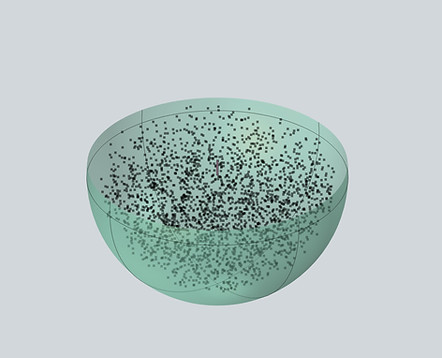
The Full Model
All components were superimposed onto one another, creating an output consitent with intracortical recordings. Parameter sweeps
in tip length were conducted.
ZONE A ONLY

FULL MODEL

MATLAB LiveLink Integration
Model Automation
Model generation was automated through a hybrid NEURON–FEM workflow. Currents from NEURON and biological noise signals were extracted and recompiled in COMSOL via MATLAB Livelink, supporting scalable and reproducible simulations.
Results
Key Findings